

With Bitcoin plunging below $60,000 and Strategy’s share price down by more than 70% from the high, some crypto investors are questioning if Strategy could become this cycle’s Terra/LUNA — a highly leveraged bet on crypto market structure that explodes under stress.
The company’s response? A new capital framework released on Monday aimed at addressing investors’ fears.
The package includes up to $1 billion in buybacks for MSTR, up to $1 billion in buybacks for STRC and related securities, an increase in STRC’s dividend to roughly 12%, and a cash buffer expansion to $2.55 billion.
Of particular note for a company famed for its maximalist approach to Bitcoin, Strategy also said it may sell up to $1.25 billion in BTC holdings if required to meet dividend or debt obligations.
Markets responded positively to the news, with both STRC and MSTR shares rallying more than 12% in after-hours trading. STRC is currently trading at $84.86, a significant improvement on the $72.06 it was trading at on June 26.
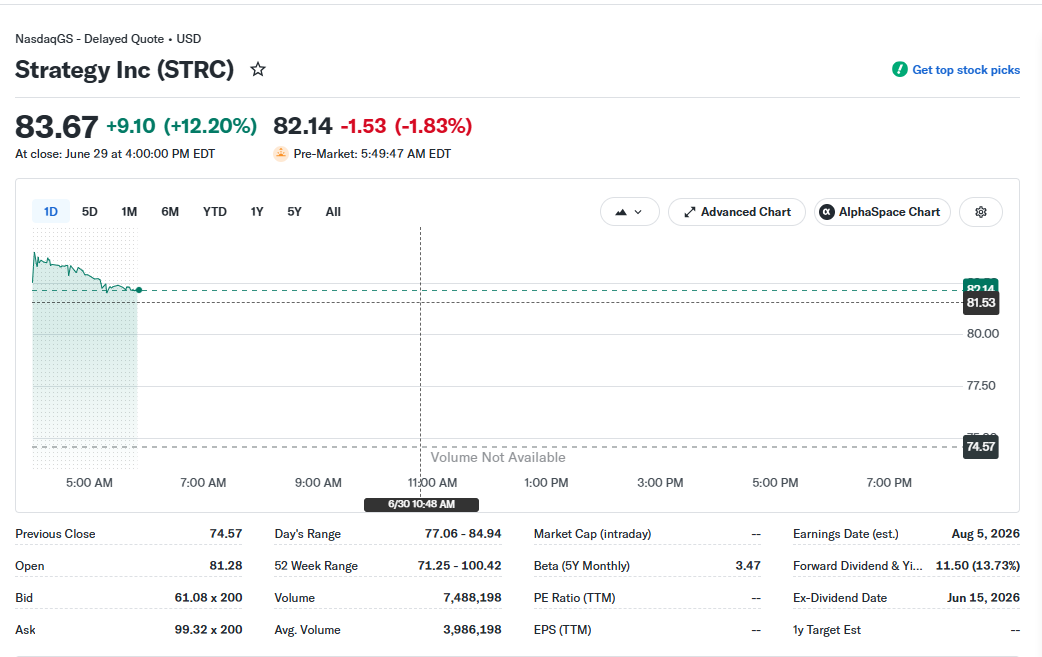
STRC share price rallied by over 12% in after-hours trading. Source: Yahoo Finance.
But is the plan enough to assuage fears that STRC’s structure — famously cooked up by CEO Michael Saylor with the help of an LLM — could expose Strategy to a “death spiral” of reflexive funding risks during periods of market stress?
What is STRC and why is it controversial?
STRC is part of Strategy’s capital structure linked to its broader Bitcoin treasury strategy. It sits between traditional equity and debt-like instruments, offering investors yield while maintaining exposure to the company’s Bitcoin holdings.
Related: Strategy’s MSTR may plunge 80% if it repeats this dot-com-era fractal
Strategy describes STRC as a perpetual preferred stock paying a 12% annual dividend on a $100 par value, funded from its cash reserve and Bitcoin-linked capital framework.
While the structure is designed to provide financing flexibility without issuing traditional debt, analysts have questioned whether its stability depends on continued investor demand in secondary markets, particularly during periods of Bitcoin volatility or tighter liquidity conditions.
By contrast, Strategy’s common stock is called MSTR and it represents an equity ownership stake in Strategy along with voting rights. The fate of the two securities is closely aligned, but they are different. Similarly, Strategy’s position as the largest buyer of Bitcoin (and perhaps in future as a seller) means its fate is closely intertwined with the price of Bitcoin at present.
Perpetual goldbug and Bitcoin critic Peter Schiff has repeatedly called out Strategy’s model, pointing out that it “can’t sell Bitcoin without crashing the price of Bitcoin. Even if Strategy merely stops buying Bitcoin, that change alone would crush the market.”

Strategy describes STRC as a short-duration, high-yield credit. Source: Strategy
Yet Taran Dhillon, head of digital assets at Kula, told Cointelegraph that “Bitcoin volatility alone is unlikely to break a structure like Strategy’s.”
He said that a more meaningful test is “whether Bitcoin remains under pressure while access to capital becomes progressively more expensive or difficult.”
The Bear case: feedback loops and liquidity dependency
Some argue that Strategy’s entire fundraising and equity model is inherently reflexive, compounding both upside and downside cycles. The same flywheel that amplifies gains in bull markets can accelerate losses during the bear, when falling Bitcoin and share prices collide with weaker demand.
Ripple CEO Brad Garlinghouse made that exact point on CNBC this week. “Financial engineering does not drive long term value,” he said.
Kyle Rodda, senior analyst at Capital.com, told Cointelegraph that Strategy effectively operates as a momentum-driven Bitcoin accumulation vehicle, in which capital raises funds for Bitcoin purchases that, in turn, support the company’s valuation. However, he warned that the dynamic can reverse under stress.
“Strategy’s business definitely compounds momentum in both directions,” Rodda said, adding that in weaker conditions, rising funding costs and declining investor appetite can reinforce downward pressure.
Related: Grayscale’s Pandl says Strategy should sell $3B Bitcoin to restore confidence
He also argued that secondary market liquidity is a structural dependency, meaning large-scale selling or refinancing pressures could have wider spillovers into Bitcoin markets themselves.
Among Bitcoiners, Charles Edwards, the founder of Capriole Investments, is one of Strategy’s most hawkish commentators of late.
He compared stressed conditions in digital asset treasury companies to broader crypto deleveraging events, warning that feedback loops can accelerate losses when leverage and sentiment deteriorate.
“Anyone else getting LUNA 2022 vibes on MicroStrategy?” he posted on June 26.
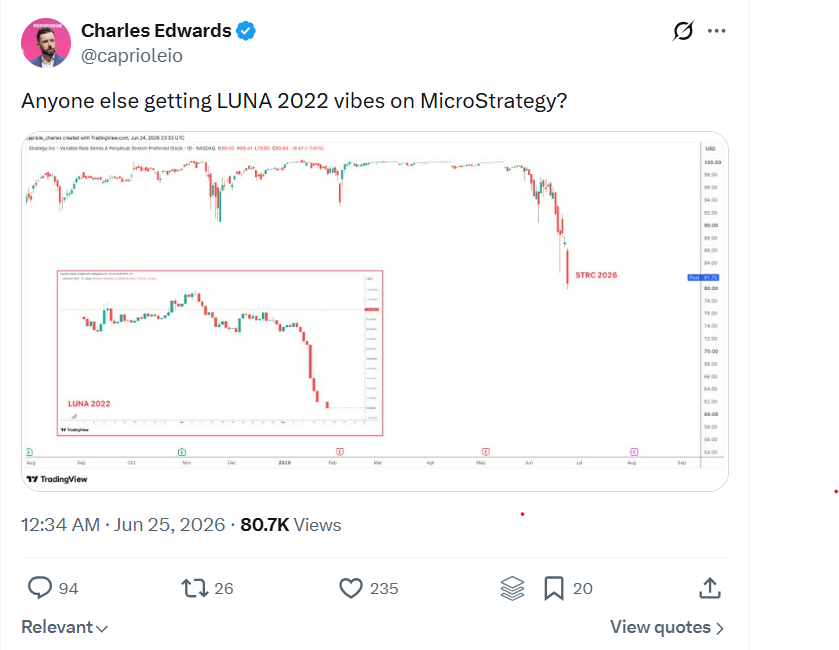
Comparing Strategy to Terra/LUNA. Source: Charles Edwards
The neutral view: the real risk is funding markets, not Bitcoin
While the bearish sentiment around Strategy piles up on X, Dhillon told Cointelegraph that stress would likely first appear in funding conditions, pointing to widening discounts, higher yields, and reduced issuance capacity as early warning signals.
In his view, Strategy’s Bitcoin holdings are less relevant than whether the company can continue refinancing or rolling capital efficiently during periods of market stress.
And while failure of STRC to maintain its “peg” of $100 has caused much consternation, STRC isn’t pegged to $100 in the way a stablecoin is pegged to the value of $1. The yield simply gets more attractive the further the price falls under $100, which in theory, should see buyers push the price back to $100 at some point.
A Bitfire Research report shared with Cointelegraph said that STRC’s recent price dislocations should not be interpreted as structural failure.
The firm argued that de-pegging events are largely driven by sentiment and liquidity conditions rather than changes to Strategy’s underlying fundamentals or solvency profile.
“Strategy (formerly MicroStrategy) faces no near-term insolvency risk,” the firm wrote.
Bull case: stress is not insolvency
Strategy supporter Adam Livingston, a Bitcoin advocate and author, ran what he described as a “three-year MSTR stress test” under extreme conditions, including a 55% Bitcoin drawdown, closed capital markets, and sustained cash burn requiring large Bitcoin sales to meet obligations.
Related: CryptoQuant warns on Strategy’s dividend coverage as cash reserve falls 38%
In his model, Strategy’s senior claims expand sharply in Bitcoin terms, while the company’s “common equity Bitcoin exposure” (CEBE) compresses significantly. He described this as “CEBE getting annihilated”, falling from 138,161 sats per share to 7,884 sats per share at the trough of the simulation.
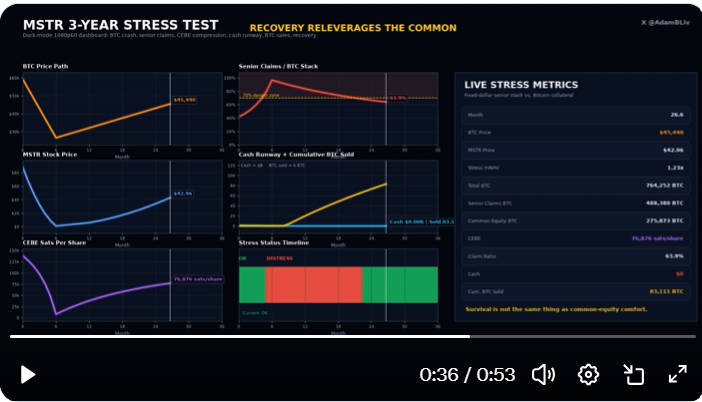
Death spiral? This model says no. Source: Adam Livingston
The model assumes no new Bitcoin purchases or equity issuance during the downturn, with approximately 115,727 BTC sold over the three years to service obligations before stabilization conditions return.
Despite the severity of the drawdown, Livingston’s model ultimately shows Strategy surviving the cycle, ending with over 700,000 BTC remaining on its balance sheet and a recovering net asset structure once market conditions normalize.
What Strategy actually changed
The new framework represents the most explicit attempt yet by Strategy to address concerns around liquidity and reflexivity risk.
Key components of Strategy’s June 29 8-K filing that aim to restore confidence in the company, include buybacks for MSTR shares and STRC and a big focus on expanding cash reserves to pay dividends. The nuclear option of selling up to $1.25 billion in Bitcoin holdings to pay dividends is included partly as a way to assure markets Bitcoin maximalist Michael Saylor will reluctantly sell assets if he’s forced to.
Related: Bitcoin price is down over 40% since STRC launched: Is Strategy ‘fine’?

Strategy’s 8-K filing, June 29. Source: US Securities and Exchange Commission
Dhillon said the framework “meaningfully improves” transparency around how Strategy would respond under stress, with the expanded $2.55 billion reserve and clearer Bitcoin monetization plan helping strengthen investor confidence.
But Schiff pointed out that the current market cap of MSTR is $30 billion, while the current value of its Bitcoin is $50 billion. “Until MSTR’s market cap rises above the value of its Bitcoin, any Bitcoin bought by issuing MSTR shares creates a negative Bitcoin yield,” he said.
A stronger toolkit, same core bet
While the framework strengthens Strategy’s ability to manage short-term stress, it does not eliminate its reliance on capital markets to sustain its broader Bitcoin accumulation strategy.
As Dhillon told Cointelegraph, the key test will be whether funding conditions remain accessible during periods of market stress, rather than Bitcoin price action alone.
He added that the update clarifies Strategy’s capital allocation playbook, and gives management a more defined order of operations, which makes its overall strategy more credible.
For critics like Rodda, the underlying concern persists. Strategy’s structure remains exposed to feedback loops if liquidity tightens across both equity and credit markets.
While Strategy’s move introduces clearer liquidity buffers, buybacks, and contingency options, including potential Bitcoin sales, the debate over structural reflexivity has not yet been fully resolved.
The question now is not whether STRC is inherently fragile in theory, but whether Strategy’s expanded toolkit can withstand a prolonged period of capital market stress, and whether investors still want exposure to a vehicle that amplifies Bitcoin’s cycles and adds risk, rather than simply tracking them.
Magazine: Bitcoin will not hit $1M by 2030, says veteran trader Peter Brandt
Features#Strategys #capital #overhaul #put #death #spiral #fears1782864343
