

Grayscale Head of Research Zach Pandl has publicly warned that Michael Saylor’s Strategy faces a structural $1.5 billion annual cash-flow problem driven by its swelling preferred-stock dividend obligations, not by Bitcoin’s price.
The trigger for that warning: Strategy sold 32 BTC for approximately $2.5 million between May 26–31, 2026, its first Bitcoin sale since 2022, with SEC filings confirming the proceeds went directly to fund preferred stock distributions.
Pandl’s framing is precise and deliberately divorced from the usual BTC price narrative. “Strategy’s leveraged business model is facing challenges, which have contributed to increased volatility in the overall BTC market,” he said in a Grayscale research note.

This is a cash-flow problem with a fixed-dollar denominator, and Bitcoin, which yields nothing, sits on the wrong side of that equation.
Discover: The Best Crypto to Diversify Your Portfolio
Bitcoin News: The $1.5 Billion Gap Strategy Can’t Paper Over
The arithmetic is uncomfortable. Strategy’s 2025 software revenue came in at roughly $477 million، less than one-third of the ~$1.5 billion in annual dividends now owed across its five preferred-stock series.
The preferred stack itself has ballooned from approximately $730 million in early 2025 to roughly $15.5 billion by mid-2026, driven by successive issuances including STRK (fixed ~8% coupon) and STRC, the “Stretch” preferred issued in 2025 at a variable rate of approximately 11.5%.
STRC was designed to trade near its $100 par value. It has been quoted around $95–96. That below-par print is not cosmetic، Pandl warns it signals that investors are already demanding higher effective yields, which could force Strategy to sweeten dividend terms on future issuances. “If Strategy is forced to increase the dividend to return STRC to $100, the company will run out of cash much sooner, pulling forward Bitcoin sales to fund payments,” he said.
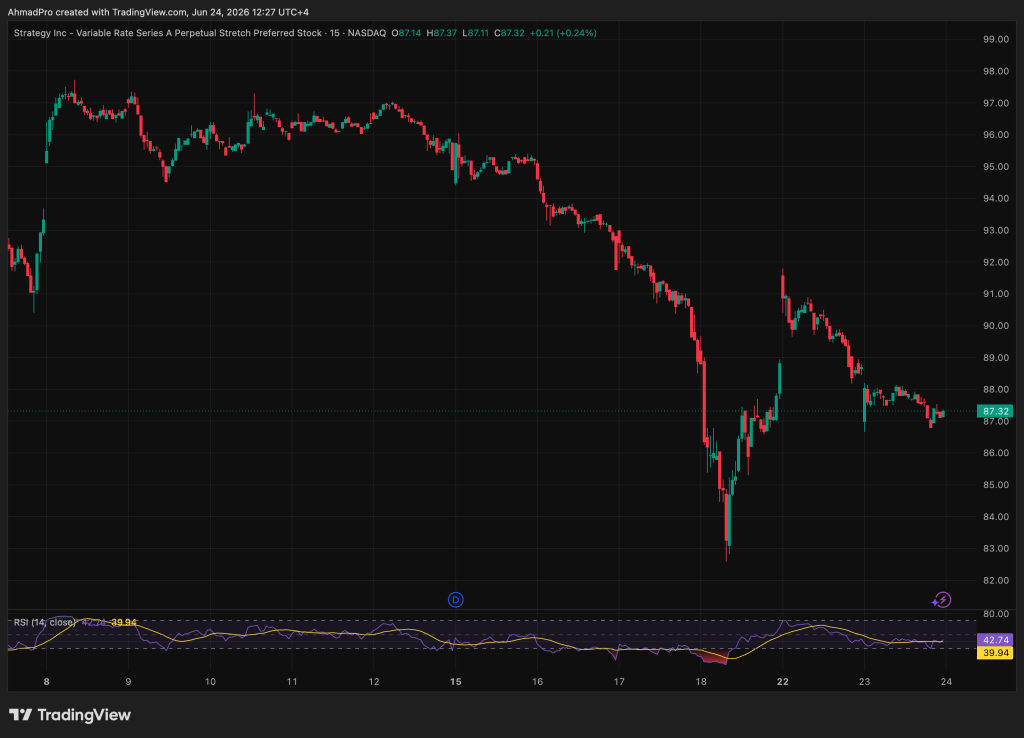
Strategy’s reported cash position of roughly $1 billion covers less than one year of preferred dividends at current obligation levels. That runway forces a binary choice on repeat: refinance at increasingly punishing terms, issue dilutive equity, or sell Bitcoin.
The May 2026 sale، 32 BTC at an average of $77,135, reducing the treasury to approximately 843,706 BTC، confirmed which lever the firm pulled first. Small in absolute terms; structurally significant as a precedent.
Arca’s Jeff Dorman has independently flagged the same mechanism, warning that the roughly $15 billion preferred stack and $1.5 billion annual dividend load mean “someone is going to lose badly” if Bitcoin prices or MSTR equity don’t cooperate within the next few months.
Two separate institutional research desks arriving at the same number from different angles is not a coincidence، it is the arithmetic speaking.
Discover: The Best Token Presales
Can Strategy Still Call Itself a Bitcoin Accumulator?
Strategy’s entire valuation premium rests on a single thesis: Michael Saylor is a permanent, aggressive net buyer of Bitcoin, and MSTR equity offers leveraged exposure to that accumulation engine.
Pandl’s note punctures that thesis from two directions simultaneously. First, the May Bitcoin sale established that BTC is now a liquid reserve tapped for operational cash needs, not an untouchable treasury asset.
Second, Pandl argues directly that Strategy “will struggle to acquire more tokens at the share prices both STR and MSTR trade at” – meaning the equity-issuance flywheel that funded accumulation in 2020–2024 is no longer economical at current MSTR prices near $125.
That distinction matters. Selling from strategic rebalancing is one thing; selling because preferred cash flow obligations leave no other option is structurally different. Saylor acknowledged as much on Strategy’s May 2026 earnings call, stating the company might sell Bitcoin to pay dividends and would signal such sales in advance.
That admission converted “never sell Bitcoin” from a policy to a preference، and preferences bend under financial pressure.
Grayscale’s note also flags the market-structure implication: if Strategy is no longer a persistent accumulator, Bitcoin now requires incremental demand from other buyers to maintain price support.
The “MSTR put”، the assumption that Saylor would step in as a buyer during weakness، is materially impaired. That removes a structural bid from the market precisely when the firm’s stressed balance sheet could make it a seller.
Don’t Miss Out on Our $1,000 USDT Airdrop on ByBit
The post Is Saylor’s Strategy Sat on $1.5Bb Cashflow Problem? Grayscale Think So appeared first on Cryptonews.
Bitcoin News,Bitcoin (BTC)#Saylors #Strategy #Sat #1.5Bb #Cashflow #Problem #Grayscale1782296267
