

In brief
- Gary Gensler, one of crypto’s most aggressive regulators, has emerged as an ally of states challenging the CFTC-backed prediction market industry.
- Gensler said concerns over gambling and addiction should be left to the states.
- As the legal fight spreads across states, tribes, gaming groups, and state regulators are increasingly challenging Kalshi’s claim of exclusive federal jurisdiction.
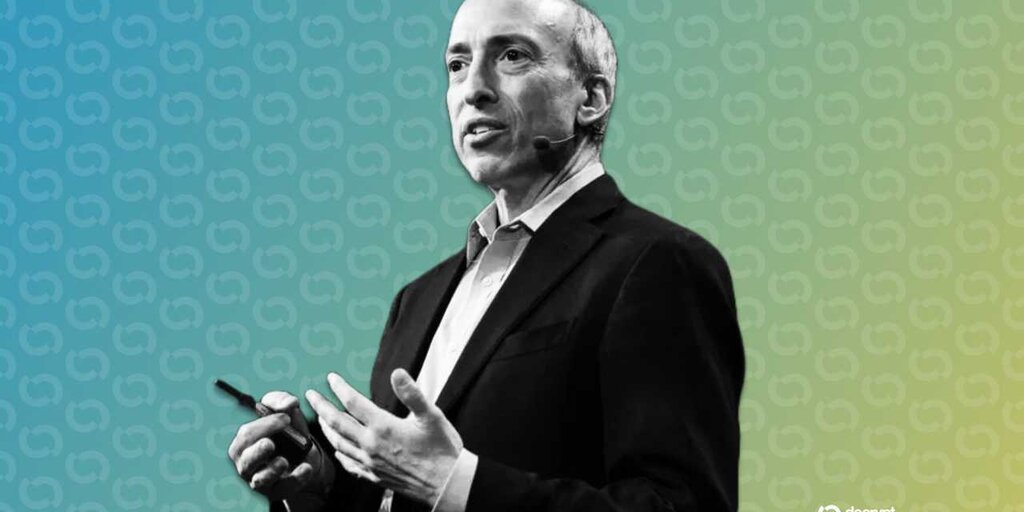
Former Commodity Futures Trading Commission and Securities and Exchange Commission chair Gary Gensler filed an amicus brief late Thursday with the Sixth Circuit Court of Appeals, saying that Congress did not hand the CFTC the keys to nationwide sports wagering when it passed the Dodd-Frank Act in 2010, and that state gaming laws still stand.
“Thirty Native American tribes and 11 tribal associations have filed an amicus curiae brief in support of Ohio in the Sixth Circuit prediction markets appeal,” gaming attorney and prediction market expert Daniel Wallach tweeted, referring to Kalshi’s appeal after federal district judge Sarah Morrison denied the platform’s request for a preliminary injunction in its challenge to state cease-and-desist orders.
30 Native American Tribes and 11 tribal associations have filed an amicus curiae brief in support of Ohio in the Sixth Circuit prediction markets appeal filed by Kalshi after it was denied a preliminary injunction by federal district court judge Sarah Morrison. pic.twitter.com/MlMofmMdY5
— Daniel Wallach (@WALLACHLEGAL) June 12, 2026
Gensler filed alongside a string of amici backing the State of Ohio: the Indian Gaming Association, the American Gaming Association, and Better Markets.
Among the co-signers with Nevada was the Utah Attorney General, representing a state where sports betting is outlawed entirely.
As SEC chair, Gensler led one of the most aggressive crypto enforcement campaigns in the agency’s history, bringing roughly 100 actions and describing the industry on his way out as “a field that was built up around noncompliance.”
He is now siding with states against a CFTC-blessed market.
The Dodd-Frank Wall Street Reform and Consumer Protection Act, the 2010 law passed after the 2008 financial crisis to regulate swaps and curb risky derivatives, is the statute the case hinges on.
Gensler, who chaired the CFTC from 2009 to 2014 and helped negotiate it, said the law was written to respond to the crash, not to authorize sports wagering.
“Millions of people were out of work. Millions of people had lost their homes,” he said in a CNBC interview, describing legislation aimed at credit-default and interest-rate swaps.
“I testified in Congress 54 times, and literally Republicans and Democrats alike, nobody said, oh, you know what? Gensler, I think we should give your small agency under President Obama authority to regulate sports betting,” Gensler said.
No one drafting Dodd-Frank, the brief adds, “was attempting to put a curve ball by the Senate Majority Leader to legalize a national sports-betting regime.”
The filing invokes the court’s warning that Congress does not “hide elephants in mouseholes,” contending that preempting a $165-billion-a-year industry would not be tucked into “a subpart of a definition.”
Gensler also opposed the CFTC’s new 267-page proposal, which would allow betting on sports outcomes while prohibiting contracts tied to war, assassination, and certain injury- and referee-related wagers.
“No, no,” Gensler said when asked if it was a step forward, contending the agency is trying to reverse a rule the CFTC adopted unanimously around 2011 prohibiting contracts on “assassination, war, terrorism, gaming or unlawful acts.”
Citing the CFTC’s shrinking workforce and concerns over youth gambling and addiction, Gensler argued that such issues are best handled at the state level, saying, “Let the states do it.”
States versus prediction markets
Sixteen states are in legal proceedings with prediction market platforms, Minnesota has banned them outright by making it a felony to operate or advertise one, and the CFTC has taken the unusual step of suing six states to defend what it calls its exclusive jurisdiction.
President Donald Trump has thrown the White House behind the federal side, calling the issue “critically important” and pressing for regulators to keep control as states treat the sector as gambling.
The administration has backed that position in court, with the CFTC and DOJ jointly suing Minnesota within hours of Governor Tim Walz signing the state’s prediction market ban into law.
Wallach tweeted that the tribal amici brief highlights the breadth of Kalshi’s position, noting the company is grounding its claim of exclusive federal jurisdiction not only in Dodd-Frank but also in the 2000 Commodity Futures Modernization Act and the CFTC Act of 1974.
“Both of those statutes go far enough back in time to qualify as ‘long-extant statutes’ for purposes of the MQD,” he wrote, invoking the major-questions doctrine, under which courts typically require explicit congressional approval for major expansions of agency authority.
Decrypt has reached out to the CFTC and Kalshi for comment.
Daily Debrief Newsletter
Start every day with the top news stories right now, plus original features, a podcast, videos and more.
polygon,Business#Gary #Gensler #Backs #States #Fight #Prediction #Market #Regulation1781264587
