

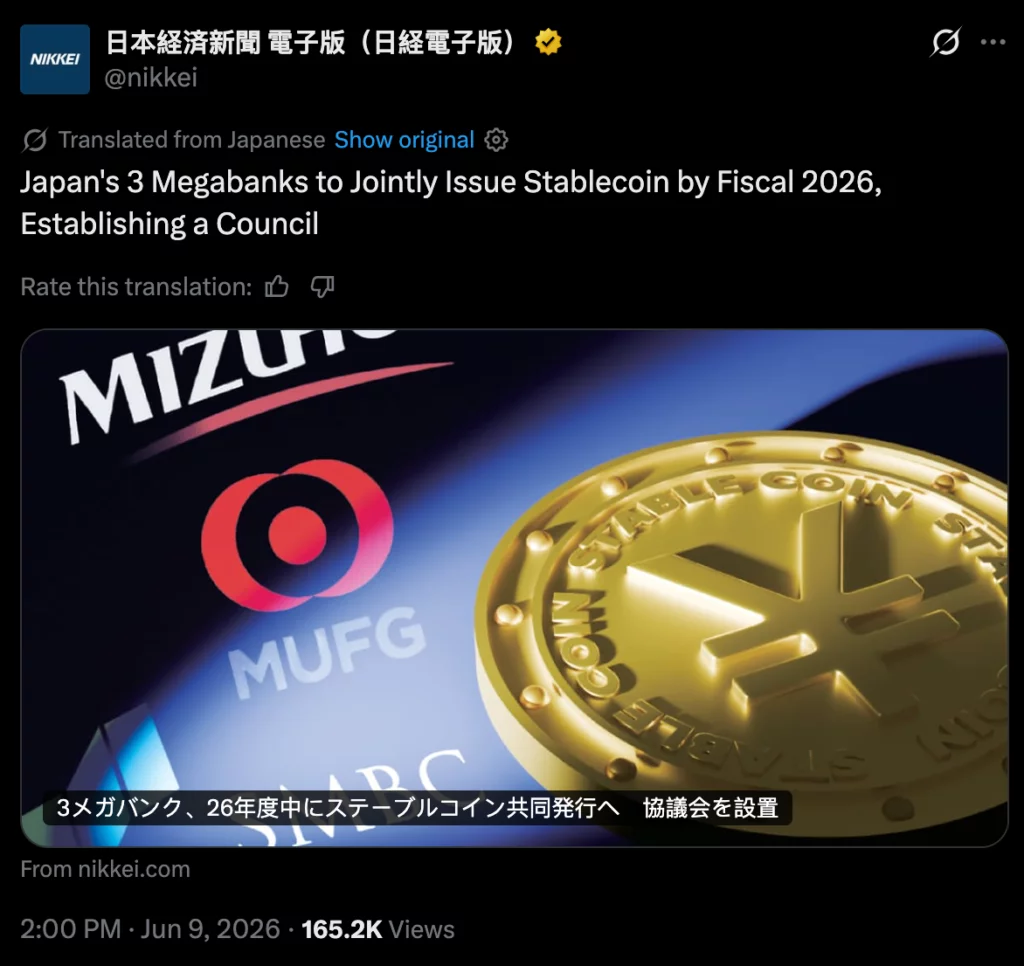
MUFG Bank, Sumitomo Mitsui Banking Corporation and Mizuho Bank plan to start live transactions with a jointly issued stablecoin during fiscal year 2026. Japan’s fiscal year ends in March 2027.
Summary
- Japan’s three megabanks target live stablecoin transactions within fiscal 2026 under a shared banking framework.
- A new council will examine issuance infrastructure, governance, operating rules, systems and future bank participation.
- The FSA-backed pilot tested corporate cross-border payments through a trust structure using Progmat’s blockchain infrastructure.
The banks signed a memorandum to create a voluntary council that will prepare the operating and governance framework. The project follows a regulatory pilot supported by Japan’s Financial Services Agency.
Three banks prepare joint stablecoin transactions
The banks will issue the stablecoin through a trust agreement. They will act as joint settlors, while a trust bank or a similar institution will serve as trustee.
The structure aims to let the banks share one issuance framework instead of developing separate tokens. The official statement did not provide the token’s issue size, blockchain network, retail access terms or precise rollout date.
“The three banks will accelerate their initiatives,” the joint statement said.
In addition, the council will examine issuance infrastructure, system design, governance and operating processes. It will also review Japanese laws and market conditions before live transactions begin.
MUFG, SMBC and Mizuho will establish the council first. The group may later work with other financial institutions and related companies that want to join the stablecoin framework.
The banks aim to support several payment uses rather than one limited test. However, they have not named the first commercial users or confirmed whether initial transactions will focus only on corporate payments.
FSA-backed pilot tested cross-border payments
The FSA supported the proof-of-concept in November 2025. The pilot examined joint stablecoin issuance and cross-border payments involving Mitsubishi Corporation’s Japanese and overseas offices.
Mitsubishi UFJ Trust and Banking Corporation handled the planned trust-based issuance structure. Progmat supplied the blockchain infrastructure, while the three banks developed requirements and assessment standards.
The pilot also reviewed legal compliance and user protection. Japan’s Payment Services Act allows stablecoins to operate as regulated electronic payment instruments when issuers meet the required structure and reserve rules.
Japan expands its yen stablecoin market
The joint bank project enters a market that already includes other regulated yen token plans. JPYC launched a yen-backed stablecoin in October 2025, while SBI Holdings and Startale have also prepared an institutional yen stablecoin.
Japan’s ruling Liberal Democratic Party has called for broader use of yen stablecoins, tokenized deposits and round-the-clock settlement. The plan also supports clearer rules for tax payments, wages and corporate uses.
The three-bank project could add a shared settlement route for major corporate clients. Its progress will depend on the council’s final design, regulatory review and connections with existing payment systems.
News,bank,Japan,Stablecoin#Japans #megabanks #target #joint #yen #stablecoin #March1781069853
