

Bitcoin has erased its post-CPI gains after renewed threats from U.S. President Donald Trump against Iran pushed traders back into risk-off positioning and sent the crypto asset below $62,000.
Summary
- Bitcoin gave up its CPI-driven gains after renewed U.S.-Iran tensions pushed traders back into risk-off mode.
- Donald Trump warned Iran would “pay the price” and signaled potential strikes on Iranian infrastructure, while oil climbed to $90 per barrel.
- K33 Research says over 50% of the Bitcoin supply is now underwater, with traders watching support near $60,000 and resistance around $64,000.
According to market data, Bitcoin (BTC) briefly climbed above $62,400 on June 10 after U.S. inflation data came in line with expectations, easing concerns that price pressures were accelerating worse than anticipated.
The inflation report showed the U.S. Consumer Price Index rose 0.5% month-over-month in May, matching economists’ expectations, while the annual inflation rate came in at 4.2%, matching forecasts. The data eased concerns that inflation was reaccelerating beyond control and briefly strengthened expectations that the Federal Reserve could keep interest rates unchanged rather than hiking them later this year.
The move proved short-lived as geopolitical developments quickly took center stage, dragging BTC back toward the $60,000 area and leaving it down on the day.
Fresh pressure emerged after Trump issued a series of posts on Truth Social criticizing Iran and signaling that military action could intensify. In one post, Trump said Iran had taken too long to negotiate and would now “have to pay the price.” Later, he escalated his rhetoric further, telling reporters that “we’re going to be attacking them very hard,” fueling concerns that the conflict could expand in the coming days.
Oil markets also reacted to the developments. According to market data, crude oil rose 2% to around $90 per barrel as traders assessed the growing risk of supply disruptions across the Middle East.
Geopolitical risks overshadow inflation relief
Although the latest Consumer Price Index report initially supported risk assets, traders shifted their focus toward the deteriorating situation in the Gulf region.
According to reports cited by CNN, flashes of light observed near a U.S. military facility in Bahrain sparked fresh attention after Iran threatened retaliation against American interests in the region. The threats followed what Iranian officials described as U.S. “self-defense strikes” conducted after the downing of an American military helicopter.
Additional reports indicated that Iran launched attacks against Bahrain, Jordan, and Kuwait, further raising concerns about a broader regional conflict. Market participants have increasingly linked the possibility of prolonged disruptions in energy markets to higher inflation risks, a development that could complicate expectations for monetary policy and weigh on speculative assets such as cryptocurrencies.
Earlier military exchanges involving Israel and Iran had already contributed to weakness across digital assets, and the latest escalation added another source of uncertainty for traders.
On-chain and derivatives data highlight key Bitcoin levels
Beyond the geopolitical backdrop, recent on-chain data suggests Bitcoin has entered a period historically associated with major market stress.
As previously reported by crypto.news, K33 Research found that more than 50% of Bitcoin’s circulating supply is now held at an unrealized loss after the cryptocurrency briefly fell below $60,000 earlier this week.
According to K33 head of research Vetle Lunde, similar readings appeared near major bear-market lows in 2011, 2018, and 2022, although he noted that the indicator does not guarantee an immediate bottom.
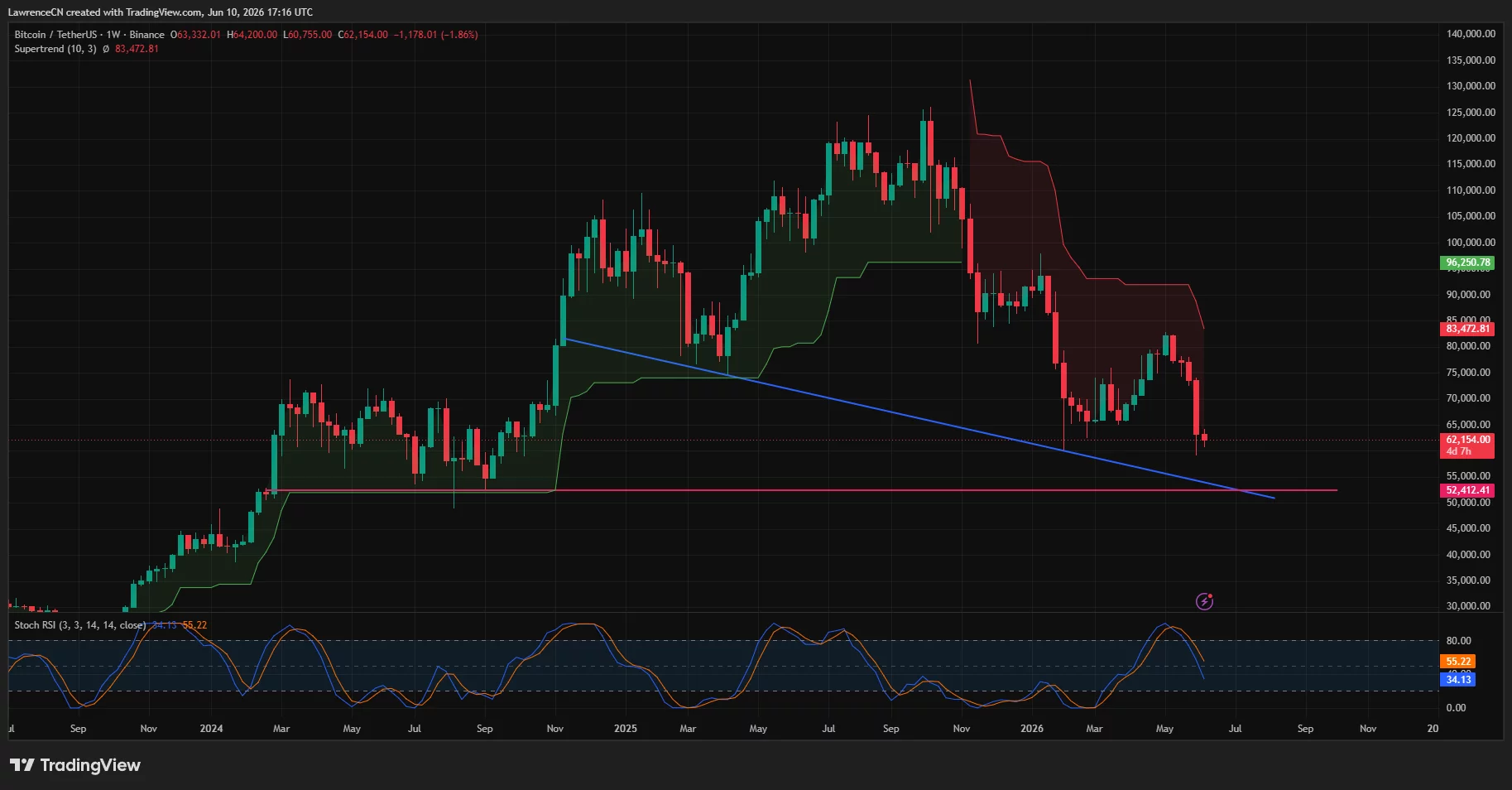
Technical indicators continue to show weakness. On the weekly chart, Bitcoin remains below a bearish Supertrend indicator near $83,500 and has broken beneath a long-term trendline that previously acted as support. Weekly stochastic RSI has also turned lower, indicating that downside momentum remains intact.
Meanwhile, CoinGlass liquidation data points to important short-term levels. The largest concentration of leveraged positions sits near $64,000, creating a potential upside liquidity target if Bitcoin rebounds.
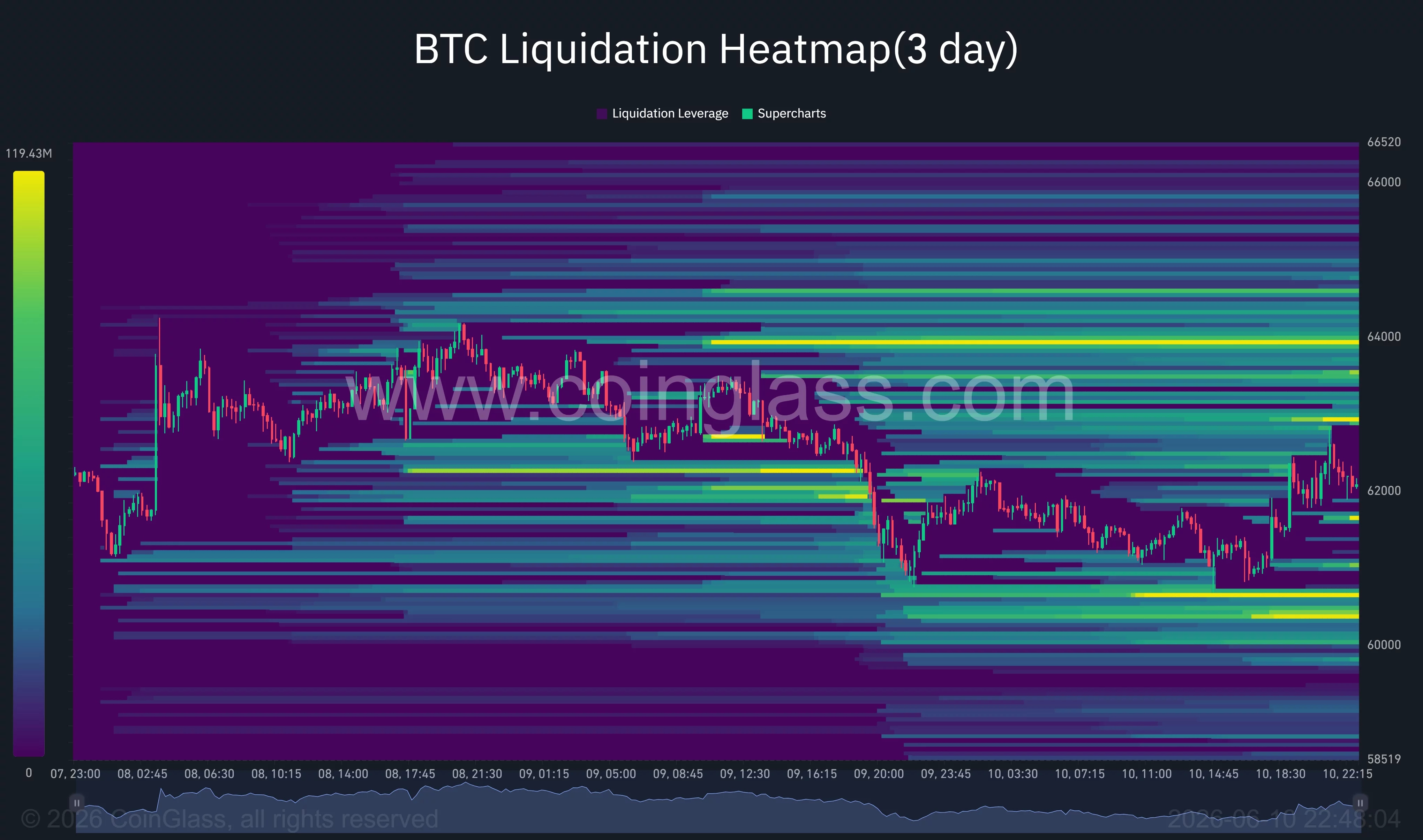
On the downside, notable liquidation clusters remain concentrated around the $60,000 to $60,500 zone, an area traders continue to watch closely as geopolitical headlines drive market sentiment.
Hence, if Bitcoin maintains support above $60,000, the next upside target could be the heavily populated liquidation zone around $64,000. Conversely, a breakdown below $60,000 may open the door to a move toward $55,000 and potentially the $52,400 support level highlighted by the weekly chart.
Disclosure: This article does not represent investment advice. The content and materials featured on this page are for educational purposes only.
Markets,Bitcoin,Inflation,interest rates,Price Analysis#Bitcoin #erases #CPI #gains #Trump #escalates #Iran #threats1781114299
