
XRP traded near $1.33 on May 31 as traders watched whether fresh exchange outflows, ETF demand and a key chart support area could help the token recover from recent weakness.
Summary
- XRP saw 25.24 million coins leave exchanges after the year’s largest inflow signaled capitulation selling.
- ETF flows added $131.94 million this month, keeping institutional demand in focus despite weakness persisting.
- Analysts watch $1.34 support, with $1.37 and $1.40 as nearby recovery targets if buyers hold.
Santiment data showed that XRP recorded its largest exchange inflow of the year on Thursday, with 22.80 million XRP moving onto trading platforms. Large exchange inflows often draw attention because they can show that holders are preparing to sell.
However, the move quickly reversed. Santiment said another 25.24 million XRP moved back off exchanges after the inflow. That shift suggests some holders withdrew coins again, reducing the amount of XRP available for immediate selling.
Santiment said the large exchange inflow happened near XRP’s local price bottom. The firm said retail traders who sold during the move were left “wishing they hadn’t” after XRP gained about 5% from that capitulation point.
The data does not confirm a full trend change. Still, the reversal in exchange flow gives traders a fresh signal to watch as XRP tries to defend its short-term price structure.
XRP price holds near $1.33
XRP traded at $1.33 at the time of writing. The token was down 0.36% over 24 hours and had slipped 2.06% over the past week.
The 24-hour trading volume stood at about $1.09 billion. XRP moved between $1.33 and $1.35 during the session, showing a narrow trading range as buyers and sellers stayed close to the same price zone.
XRP remains the fifth-largest crypto asset by market capitalization, with a market value of about $82.7 billion. Its fully diluted valuation stood near $133.4 billion, based on a maximum supply of 100 billion tokens.
The wider trend remains weak. XRP is down 3.13% over the past month and 37.47% over the past year. The token is also down more than 44% over the past 200 days.
Ali Martinez said he is watching the bottom of XRP’s rising channel at $1.34 as a possible buying zone. He said that if the level holds, the next targets sit at $1.37 and $1.40.
That setup makes the $1.34 area important for short-term traders. A clean break below it could weaken the rebound case, while a close above $1.40 may show that buyers are regaining control.
ETF demand adds another layer to XRP market
XRP ETFs reportedly recorded $131.94 million in net inflows this month. The figure adds to the view that regulated XRP products are still attracting demand despite the token’s recent price weakness.
As previously reported by crypto.news, Morgan Stanley disclosed holdings in two XRP-focused exchange-traded funds. The bank reported 1,700 shares of the Volatility Shares XRP ETF and 100 shares of the Grayscale XRP ETF in a first-quarter filing.
The positions were small compared with Morgan Stanley’s wider portfolio. Still, the filing placed the bank among institutions gaining XRP exposure through regulated investment products.
Earlier reports also showed that XRP investment products attracted $85.8 million in inflows over three weeks. During the same period, Bitcoin and Ethereum funds recorded large net outflows.
That contrast gives XRP a stronger institutional angle than its weak spot price suggests. However, ETF inflows alone do not guarantee a price rally. XRP still needs stronger demand in the open market and a clean break above resistance.
XRPFi narrative grows around collateral and yield
XRP’s market story is also expanding beyond payments. RippleX recently shared comments on how XRP can be used as collateral for yield strategies.
The example included wrapping XRP as FXRP on Flare, borrowing stablecoins against it, and deploying those assets into protocols. It also pointed to vault-based strategies across XRPL and Flare.
This matters because XRP has long been known mainly for payments and liquidity. A stronger collateral and yield narrative could give holders more ways to use the asset beyond simple transfers.
Flare-related XRPFi products already aim to place XRP into lending, vault and DeFi structures. These tools may help turn idle XRP into productive capital, although they also bring smart contract, liquidity and market risks.
CW said XRP/BTC has stayed inside an eight-year downtrend channel and argued that a break could start a new cycle. That remains a market view, not a confirmed breakout.
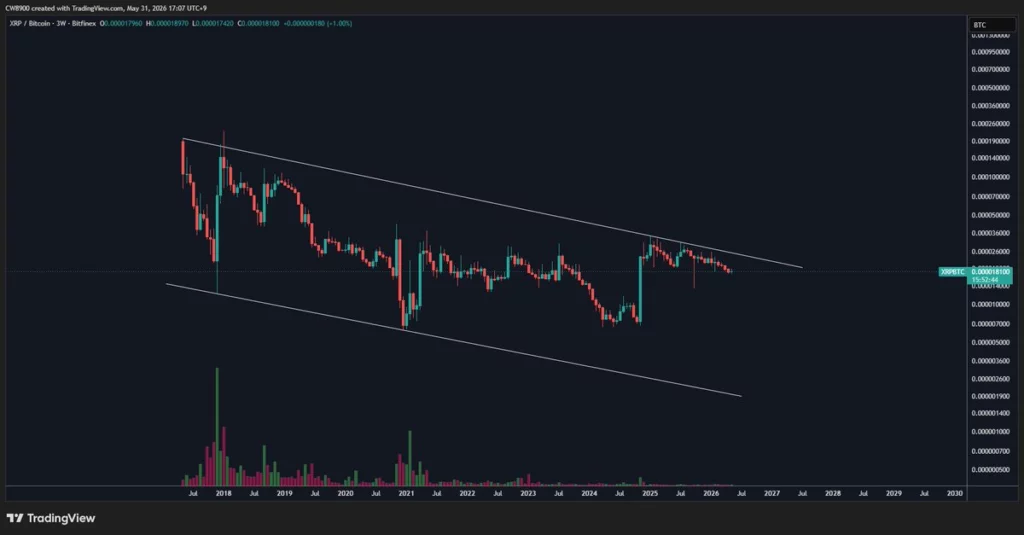
For now, XRP’s path is tied to three levels. The $1.34 area remains the support zone to defend. The $1.37 mark is the first recovery target. The $1.40 level is the main near-term test for stronger buyers.
If exchange outflows continue and ETF demand stays positive, XRP may have room for a short rebound. If $1.34 fails, traders may shift focus back to lower support levels.
Disclosure: This article does not represent investment advice. The content and materials featured on this page are for educational purposes only.
Markets,ETF,outflows,Price Analysis,XRP#XRP #price #rebound #Exchange #outflows #ETFs #lift #recovery #hopes1780225959
